From First Day to Capstone: Inside AHS' 4‑Year, Real‑World Learning Arc
When a Durango teenager signs on as a wildland firefighter right after graduation, or co‑authors a research paper with a college engineering professor, or heads to Pitzer College already influencing the politics of public art, you might assume they came from an elite magnet program or a huge urban district.
In reality, they graduated from a small, free public charter school tucked into the mountains of southwest Colorado.
Animas High School in Durango was founded in 2009 by a group of parents and educators, led by pediatrician Dr. Jesse Hutt. She’d grown tired of hearing young patients describe school as “fine” at best, and started to imagine a different kind of learning community—one that made school feel challenging, purposeful and deeply connected to real life.
After researching models around the country, the founders landed on High Tech High in San Diego as their inspiration, building a charter that adapted many of its proven practices: project‑based learning, tight‑knit relationships and an expectation that students would do real work with real stakes.
Today, Animas is a college‑preparatory charter school of about 240 students, co‑located on the Fort Lewis College campus in a solar‑powered, purpose‑built facility with a maker space, art studio, digital lab, music lab and flexible breakout spaces designed for projects. Its mission is straightforward and ambitious: prepare all students for post‑secondary success through project‑based learning, with a strong emphasis on critical thinking and engaged citizenship.
What makes Animas distinctive isn’t a single program, but a four‑year sequence of experiences that grows with students—from curiosity and exposure in 9th grade to college‑level research and community impact by 12th grade.
9th and 10th Grade: Curiosity, Exposure and Real Skills
From the moment they arrive, 9th graders enter a school culture that treats them less like passive recipients of information and more like emerging problem‑solvers. Career and college exploration starts early, with intentional exposure to many kinds of work so students begin to see beyond the narrow band of jobs they already know through family or media and think creatively about future opportunities – roles that haven’t even been invented yet.
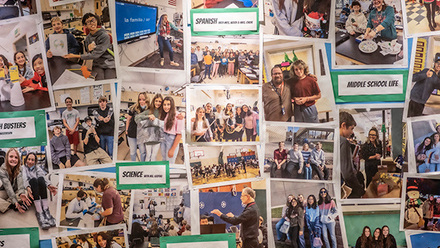
One of the most visible experiences that cuts across all four grade levels is Osprey Block—a multi-week, interdisciplinary, academic intensive that brings 9th–12th graders together in mixed‑grade cohorts. Each Osprey Block carries academic credit and blends classroom study with hands‑on (often outdoor) experiences.
In one recent Osprey Block called Adventure & Activism, students dug into regional conservation issues, then headed out on a pack‑rafting trip and completed trail work in partnership with Bears Ears Coalition. It’s a powerful way for younger students to see older peers taking on real responsibility and contributing to the community.
Animas faculty design Osprey Blocks collaboratively, balancing outdoors‑focused options with non‑outdoorsy choices to meet diverse interests.
By the end of 10th grade, many students have already accumulated meaningful skills, from wilderness first aid to technical and artistic abilities sharpened in the school’s labs and studios. Just as importantly, they are gaining confidence: standing up in front of peers to share project work, collaborating on complex tasks and seeing that their learning has tangible outcomes.
11th Grade: Real Work in the Real World
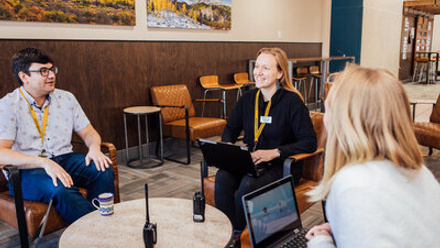
Junior year is a turning point at Animas, when every student participates in LINK Internships, a three‑week, full‑time, 90‑hour minimum internship that is a graduation requirement.
Unlike many high school “job shadow” experiences that happen in short bursts after school, LINK asks juniors to step away from regular classes for three full weeks. During that time, they don’t come to school—they go to work.
The groundwork has been laid carefully. Since 9th grade, students have been exploring careers and reflecting on their interests. As juniors, they meet one‑on‑one with Animas’ internship and work‑based learning coordinator to identify potential fields and organizations where they might intern.
They build resumes, practice interview skills and rehearse something many teenagers find terrifying: picking up the phone to call a potential mentor. While the school maintains a deep network of community partners, both in Durango and beyond, the expectation is that students will take the lead in securing their own placements, with guidance rather than hand‑holding.
The results are often transformative.
One student discovered a passion for emergency response during an Osprey Block. After earning wilderness first aid certification with support from a local fire department, he pursued a LINK internship with the Upper Pine River Fire Protection District. That experience led to a post‑graduation job offer; he later trained as a wildland firefighter.
Another recent student, a competitive cyclist with strong STEM interests, split his LINK time between a local shop, Second Avenue Sports, and the bike component company SRAM. In addition to helping with the business side of cycling, he beta‑tested components and—according to his mentor—uncovered a bug their engineers hadn’t found. At the same time, he was winning boys varsity mountain bike races, seeing clearly how his personal passions and potential career path could intersect.
Another student interned at the public defender’s office, gaining direct exposure to the justice system and deepening her commitment to law and social justice. Yet another student, who had traveled to Costa Rica during an Osprey Block to serve at an animal rescue center, chose to return there for her LINK internship to extend and deepen her expertise and impact.
In each case, the point isn’t just a résumé line. It’s about giving students a safe and authentic way to test hypotheses about their futures—either confirming, “Yes, this is for me,” or realizing early, “No, this isn’t what I want,”—before investing years and tuition in the wrong direction.
12th Grade: College‑Level Research and Community Impact
Senior year at Animas culminates in a Senior Project, a year‑long capstone that synthesizes everything students have learned into college‑level work with real‑world consequences.
The Senior Project has three major components:
- An original research question and paper. In the fall, students work closely with their senior humanities and statistics teachers to develop rigorous research questions. They learn to locate and evaluate sources, design basic studies and analyze data. The outcome is a substantial, college‑style research paper.
- A TED‑style thesis defense. Each student gives a public talk where they present their argument and findings and respond to questions, practicing the kind of poised, persuasive communication that will serve them well in college and career.
- An action project. Finally, students design and carry out an action project that puts their learning into practice, often in service to the community.
The range of topics is striking. Recent questions include:
- What are the strongest methods for teaching a second language to adolescents to move toward bilingualism?
- Out of carbon nanotubes, aerogels and fusion technology, which will have the greatest effect on space travel in the near future?
- How can we design interior spaces to have a positive impact on mental health?
- What is the function of the trickster character in folklore?
One graduate, Rosie, focused her Senior Project on the transformative power of street art as a political act.
For her action project, she designed a collaborative mural process at Animas, inviting input and help from the broader school community. Now at Pitzer College, she’s writing about a local controversy over murals in Pamona, California — an “artivism” through‑line that traces directly back to the thinking she began at Animas.
Other seniors extend relationships begun through LINK Internships. Through Animas’s co‑location with Fort Lewis College, several students have worked with computer engineering professor Dr. Yiyan Li, progressing from junior internships into senior projects that involve high‑level coding and research. One graduate even co‑authored a peer-reviewed paper with him.
Small School, Big Campus
Throughout all four years, Animas’s partnership with Fort Lewis College is a powerful thread.
Students walk across the road during the school day to attend dual‑enrollment courses at no cost to them. A dedicated Fort Lewis staff member comes to the Animas campus to co‑advise on class selection and registration. Education majors and faculty regularly use Animas as a lab school, observing project‑based teaching in action and sometimes completing practicum hours in classrooms. Adventure education and engineering departments collaborate on electives, internships and mentoring.
In many ways, the partnership gives Animas students the best of both worlds: the intimacy and personalization of a 240‑student high school, alongside the opportunities of a college campus.
It’s a vision that remains grounded in the school’s origins. One of the two teachers who came from High Tech High to help launch Animas, Lori Fisher, is still on staff as interim director of curriculum and instruction and senior humanities teacher. That kind of continuity has helped sustain a culture where students are known well enough for adults to help them effectively combine their interests, opportunities and long‑term goals.
The result is a high school experience that feels less like a checklist of courses and more like a developmental arc: 9th and 10th graders exploring and building skills, 11th graders stepping into real workplaces, and 12th graders thinking, writing and acting at a collegiate level.
In a world where college and career paths can feel both high‑stakes and opaque, Animas High School offers a different promise: four years of structured, supported experimentation that prepares students not just to get into the next step, but to thrive once they’re there.
Learn more about Animas High School’s mission and model at https://animashighschool.com.