Better Outcomes, More Choices: Colorado Charter Schools Advance Student Success

Hands-on, expeditionary learning in Pueblo. A flexible pathway for students who need a different route to graduation in Colorado Springs. Specialized academic and language support for newcomer students across the Denver metro area. Colorado charter schools look very different from one another, and that is precisely the point.
Colorado charter schools’ varied models give families more options and allow schools to design programs around the students and communities they serve. This year’s Colorado Measures of Academic Success (CMAS) results suggest those choices are producing strong outcomes: Across several key measures, Colorado charter schools are outperforming their traditional public-school peers.
Strong Results Across Key Measures
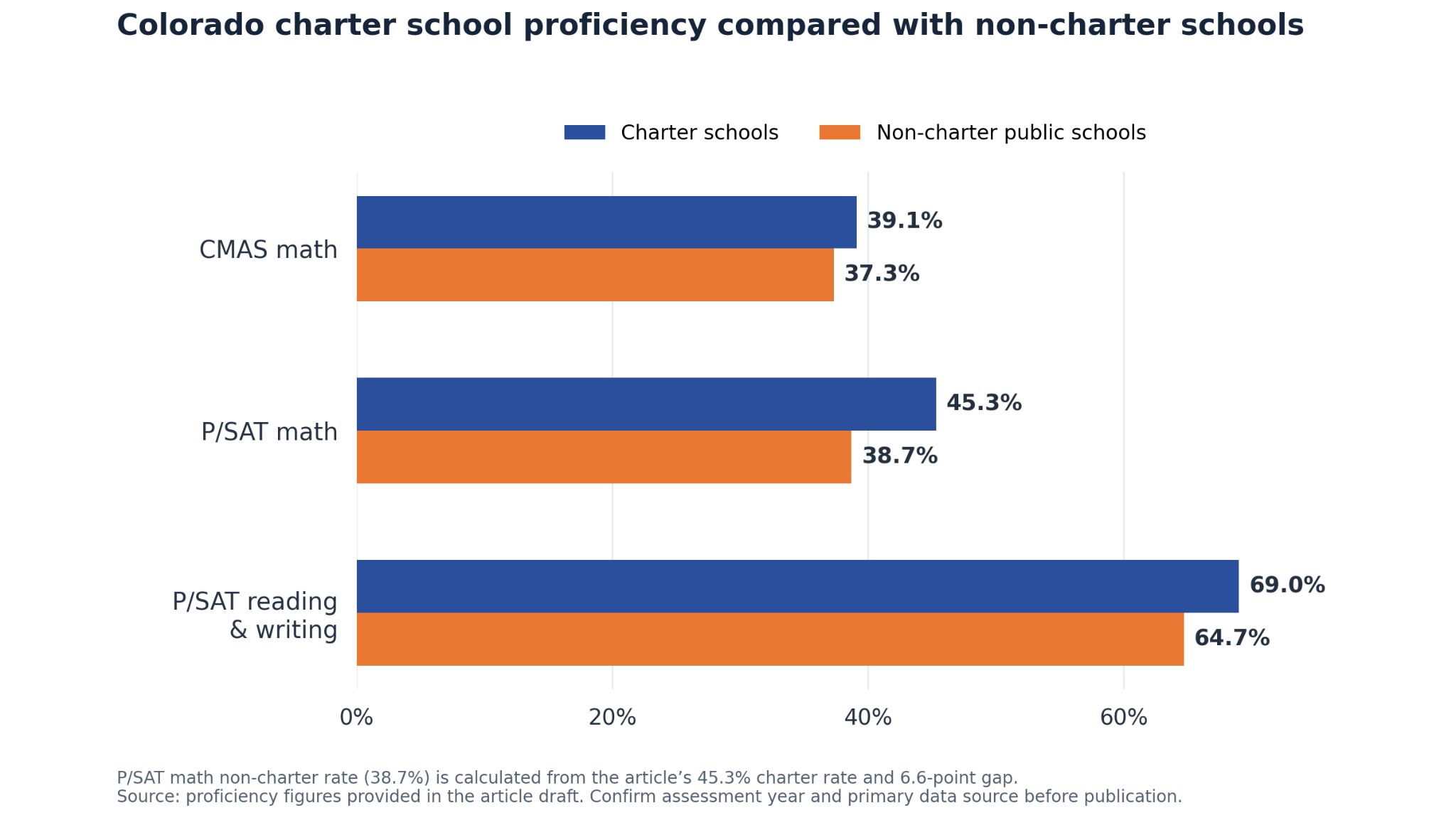
On CMAS math assessments, public charter schools posted a proficiency rate of 39.1%, compared with 37.3% for non-charter public schools.
The difference is more pronounced on P/SAT math assessments.
Charter-school proficiency increased from 42.4% to 45.3% year over year—a 2.9-point gain. Non-charter public schools improved by 1.5 points, widening the charter advantage in math from 5.2 percentage points to 6.6 points. In P/SAT reading and writing, charter proficiency held steady at 69.0%, compared with 64.7% for non-charter schools.
The results also highlight the value of viewing school performance in context. Charter ELA proficiency dipped slightly on CMAS while non-charter schools edged up. Individual schools and student populations also produce different results. But the broader picture shows charter schools continuing to improve and outperform district-run schools in the aggregate on several important measures.
Those statewide results become more meaningful when viewed alongside the range of schools and models producing them.
Villa Bella: Learning by Doing in Pueblo

At Villa Bella Expeditionary School in Pueblo, students spend each semester investigating a significant question or real-world issue through a long-term expedition that integrates Colorado academic standards across subjects. The model combines academic rigor with character development, collaboration and hands-on learning.
Students connect classroom lessons to professional expertise and community experiences. Sixth-graders, for example, learned about biological functions, organs and cells from a registered nurse and a medical student. In a wilderness class, a Lake Pueblo State Park resource technician guided students through emergency-response scenarios involving injuries far from hospital or ambulance services.
Middle school journalism students explored graphic-novel development and yearbook production with a professional author and illustrator, while a local firefighter shared lessons about fire safety and life on the fire line.
These experiences reflect Villa Bella’s “less lecture, more doing” approach. Students investigate authentic questions, engage with subject-matter experts and apply their learning beyond the textbook.
Community Prep: A Flexible Pathway in Colorado Springs

At Community Prep in Colorado Springs, students are encouraged to start where they are and build toward where they want to go. The alternative high school offers small classes, self-paced and hybrid learning, a four-day week and counseling support—flexibility that helps students stay engaged while working toward graduation.
Students also connect their interests to real opportunities. One student developed culinary skills in the school kitchen while pursuing ServSafe® Manager certification. Another completed an internship with a local floral business owner, gaining experience in design, customer service and entrepreneurship. A student who earned a certified nursing assistant credential demonstrated how Community Prep helps students translate their education into career preparation.
Community Prep’s student-centered model offers a different route for students who do not fit within more traditional school models. By building on students’ interests and providing individualized support, the school helps them move toward graduation and their next opportunity.
New America School: Supporting Newcomer and Nontraditional Students
Across its Colorado campuses, New America School serves recent immigrants, English language learners, young parents, working students and other learners who need a flexible, personal path to a diploma. Students ages 14 to 21 receive intensive English instruction and academic support while balancing work, family responsibilities or the transition to life in a new country.
Day and evening classes, a four-day school week and quarterly enrollment help students enter or return to school when the timing works for them. Newcomer Centers provide targeted language instruction, while counselors and staff offer academic, personal and career guidance. Child-care assistance helps young parents remain engaged.
Learning is connected to life after high school. Students meet with representatives from apprenticeship programs, skilled trades, the military and colleges to explore career pathways and consider their options beyond graduation.
New America’s model recognizes that students arrive with different experiences, responsibilities and goals. By combining language development, flexible scheduling and individualized support, the school creates pathways for newcomer and nontraditional students to earn a diploma and pursue their futures.
Together, these schools demonstrate why choice matters. Colorado’s charter sector is not defined by a single approach; it is defined by the ability to serve students in different ways. The data shows strong outcomes, and these schools show what those outcomes look like in practice.