What is the Colorado League of Charter Schools?
By: Peter Mason, VP Communications
The Colorado League of Charter Schools is a nonprofit organization that supports Colorado's public charter schools through advocacy, professional development, policy leadership, and school services. Since 1994, the League has worked to improve educational opportunities for students across Colorado.
"The League was founded as a nonprofit to ensure that all students can succeed in public schools by choosing the school that works best for them," said Dan Schaller, League President. "We work hard every day supporting our 262 charter schools in Colorado with services to increase quality, advocacy for better policy for public school students, and financial support through our Great Schools Colorado grant-making program."
What does the League do?
The League helps charter schools succeed by providing:
- State and federal policy advocacy
- Professional development for educators and school leaders
- Board governance training and resources
- Charter school startup and expansion support
- School quality and accountability programs
- Networking opportunities and statewide conferences
- Operational guidance and best practices
- Research, data, and policy analysis
These services help charter schools build strong organizations that deliver high-quality educational opportunities for students.
What is a charter school?
A charter school is a tuition-free public school that operates under a performance contract, or charter, with an authorizer. Like all public schools, charter schools are open to all students, accountable for academic results and financial stewardship, and funded with public dollars.
Charter schools have greater flexibility in curriculum, staffing, scheduling, and instructional design than many traditional public schools. In exchange for that flexibility, they are held accountable for meeting performance goals established in their charter contracts.
Why do charter schools matter?
Students learn differently, and no single educational model works for every child. Charter schools expand public school choice by offering families additional high-quality educational options tailored to different learning styles, academic interests, and community needs.
Strong charter schools encourage innovation, create new opportunities for educators, and contribute to a diverse and responsive public education system.
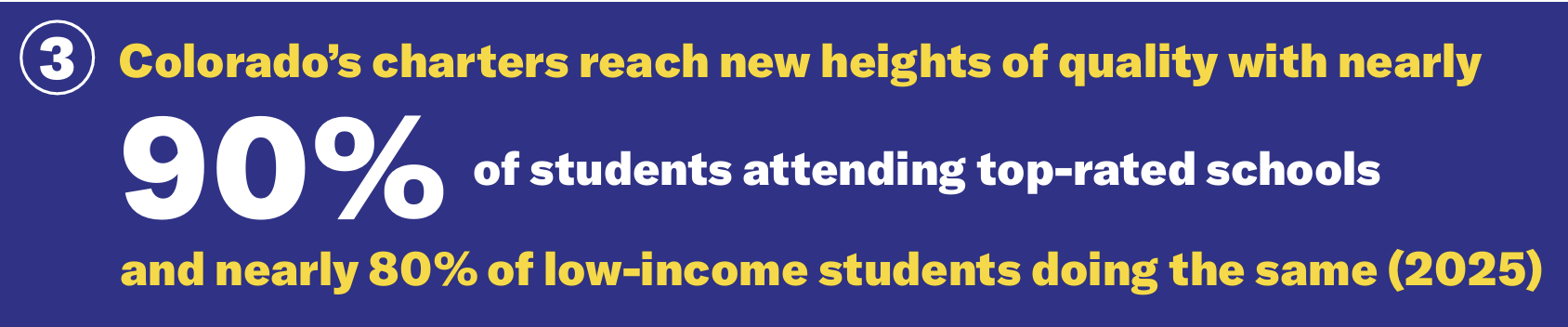
Data from the Colorado Department of Education indicate that 90% of students in Colorado charter schools attend a performance-rated school, while 80% of low-income students attend performance-rated schools.
What is the League’s mission?
The Colorado League of Charter Schools exists to improve student outcomes by strengthening Colorado's public charter schools.
Everything we do—from advocacy and leadership development to governance support and professional learning—is focused on helping schools succeed so that students can thrive.
What is the League’s vision?
We envision a Colorado where every student has access to a high-quality public school that meets their unique needs and prepares them for success in college, career, and life.
What is the League’s history?
Colorado became one of the nation's early charter school states when the Charter Schools Act was signed into law in 1993. The first charter schools opened later that year.
The Colorado League of Charter Schools was established in 1994 to support the state's growing charter school community. Since then, the League has partnered with schools, educators, policymakers, and community leaders to strengthen public charter schools and expand educational opportunities for students across Colorado.
Frequently Asked Questions
Is the Colorado League of Charter Schools a government agency?
No. The League is an independent nonprofit membership organization that serves Colorado's charter school community.
Is the League an authorizer?
No. The League is a member organization.
Who are charter school authorizers in Colorado?
There are two types of authorizers in Colorado: the State Authorizer, the Colorado Charter School Institute (CSI), and local school districts. School Districts that maintain "exclusive charter authority" (ECA) in Colorado may authorize charter schools."
From the Colorado Department of Education's Website: "District & Authorizer Information: Colorado charter schools are public schools that operate by way of a contract (charter) that has been authorized by a local school district or the Colorado Charter School Institute (CSI). The following links provide more information about Colorado school districts and charter school authorizers." Source.
Who does the Colorado League of Charter Schools serve?
The League serves charter school leaders, teachers, governing boards, school staff, authorizers, education partners, policymakers, and families interested in high-quality public education. Charter schools are free, open to all, community-based, and accountable to the community and to the authorizer who oversees to them.
How many charter schools exist in Colorado?
The Colorado Department of Education assigned 262 School Codes to charter schools authorized in the 2025-2026 school year.
How does the League support student success?
The League supports student success by helping all Colorado charter schools become stronger organizations through advocacy, leadership development, governance support, professional learning, operational resources, and school quality initiatives.

How can schools or organizations get involved?
Schools can become League members to access professional learning, governance resources, advocacy updates, conferences, and operational support. Community organizations, partners, and sponsors can also collaborate with the League to strengthen educational opportunities across Colorado.