
Preliminary State Ratings Show Strong Charter School Performance
By Kevin Hesla
The League reviewed preliminary 2026 School Performance Framework (SPF) ratings data that was recently released by CDE. The results reveal a clear and consistent pattern that Colorado charter school students across every major demographic group are more likely than their non-charter peers to attend a school rated “Performance” the state's highest accountability category.
When the preliminary ratings are examined by student demographics, the pattern is remarkably consistent. Whether looking at students by race and ethnicity, family income, multilingual learner status, or disability status, charter school students are more likely to be enrolled in performance-rated schools than comparable students attending non-charter schools. And the consistency of this finding is particularly important.
Enrollment in Performance Rated Schools: 2026 Preliminary SPF Ratings
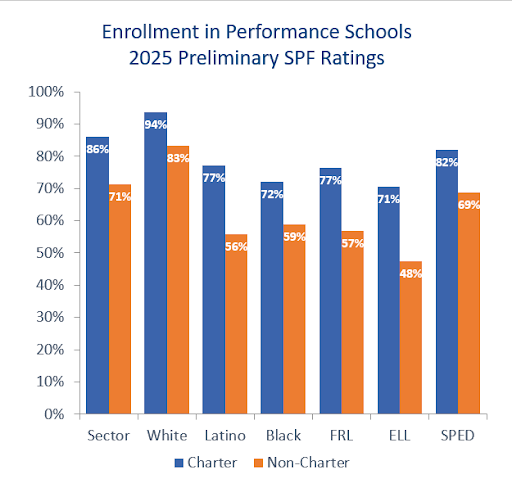
Colorado continues to face substantial differences in educational outcomes among student groups. Students from low-income families, multilingual learners, students with disabilities, and many students of color have historically had less access to high-performing educational opportunities. Closing those gaps requires more than improving statewide averages. It requires ensuring that students from every background have meaningful access to schools where students are succeeding. The preliminary SPF results suggest charter schools continue to play an important role in expanding that access.
This does not mean every charter school is successful, nor does it mean charter schools alone can eliminate longstanding disparities in educational outcomes. Outcomes across Colorado’s charter schools naturally vary, just as they do across the broader public education system. However, the results for the most historically underserved student groups are particularly compelling.
Low-income students and English language learners attending charter schools are both 10 percentage points more likely to attend performance-rated schools than their non-charter peers. For Black students, the difference between the two sectors is even more substantial: 15 percentage points.
But the statewide pattern deserves attention. If charter school students from every major demographic group are more likely to attend schools earning Colorado’s highest ratings category, policymakers should be asking what they can learn from our schools—and how more families can gain access to similarly strong educational opportunities.
That is especially important because families experience public education at the school level. A student does not attend a statewide average or a school sector. A student attends a particular school, with particular teachers, expectations, programs, and opportunities. For families, therefore, access to a high-performing school is not an abstract policy question. It can shape a child’s academic trajectory and future opportunities.
Colorado’s charter schools were created in part to provide families with additional public school options and to create space for educators to develop different approaches to serving students. Three decades later, state ratings data continue to offer an important measure of that promise.
In a state still working to ensure that every child—regardless of race, income, language, or ability—has access to an excellent public education, that is a result worth understanding, protecting, and building upon.